DESIGN REVISION R4 / A COHESIVE CABINET
Everything in its place.
Nothing over the plate.
One compact enclosure, two fresh-food banks, and an integrated utility column. Original tray and hopper sizes retained. Printed corner covers, consistent panel gaps, and numbered access points make the system easier to understand and refill.
Compact around the mechanism
The long fixed MGN guides are replaced by a side-mounted telescopic-slide candidate. The original pan still slides forward and tips. Moving the pivot toward the pouring end lets the back rise in the forward corridor, lowering the rack. Both purchased driver cabinets rotate into the right column; the battery sits beneath them, the wet compartment sits forward, and the cooling unit sits in the shaded rear air zone.
| Envelope / capacity | R4 candidate | Design implication |
|---|
| Cabinet body | 1550 W × 1540 D × 1800 H mm nominal | Allow ~10 mm local hardware tolerance; access and cooling clearances are additional. |
| Cabinet + open plate | About 1550 W × 2090 D × 1800 H mm | Compared with R3's 1900 × 3210 × 2490 mm hardware envelope: about 47% less footprint and 62% less bounding volume. These are packaging comparisons, not thermal volume. |
| Fresh food | 7 + 7 original 327.2 × 265.2 × 101.6 mm pans | No two-whole-head fit requirement. Existing pan capacity is unchanged. |
| Pellet hopper | Original 170 × 160 × 180 mm body, ≥2 L target | No two-gallon requirement. Rectangular exterior volume is not usable fill capacity; cone, lid and seller variant still need selection. |
| Slide / tier pitch | 350 mm commanded travel / 150 mm pitch | Accuride 3832E14 reference: 350 mm closed, 356 mm rated travel, 45.7 mm high, 12.7 mm side space plus tolerance. Exact weather-resistant Amazon/McMaster variant is pending. |
| Tip sweep envelope | 69 mm ceiling / 28 mm front-wall nominal margin | Conservative pan-and-cradle rectangle sampled at 0.25° steps from 0–110°. 63 mm separation from the next stored cover after extension. Not a complete tolerance / deflection / cable / hardware collision certification. |
| Eating surface | Original 812.8 × 406.4 mm plate, 1000 × 580 mm rounded surround | Outlet solids stop before the plate footprint. No cabinet, hose, motor or moving tray directly above it. |
Four ingredients. Four clear access points.
01 / GREENS · 02 / PRODUCENumbered fresh-food banks
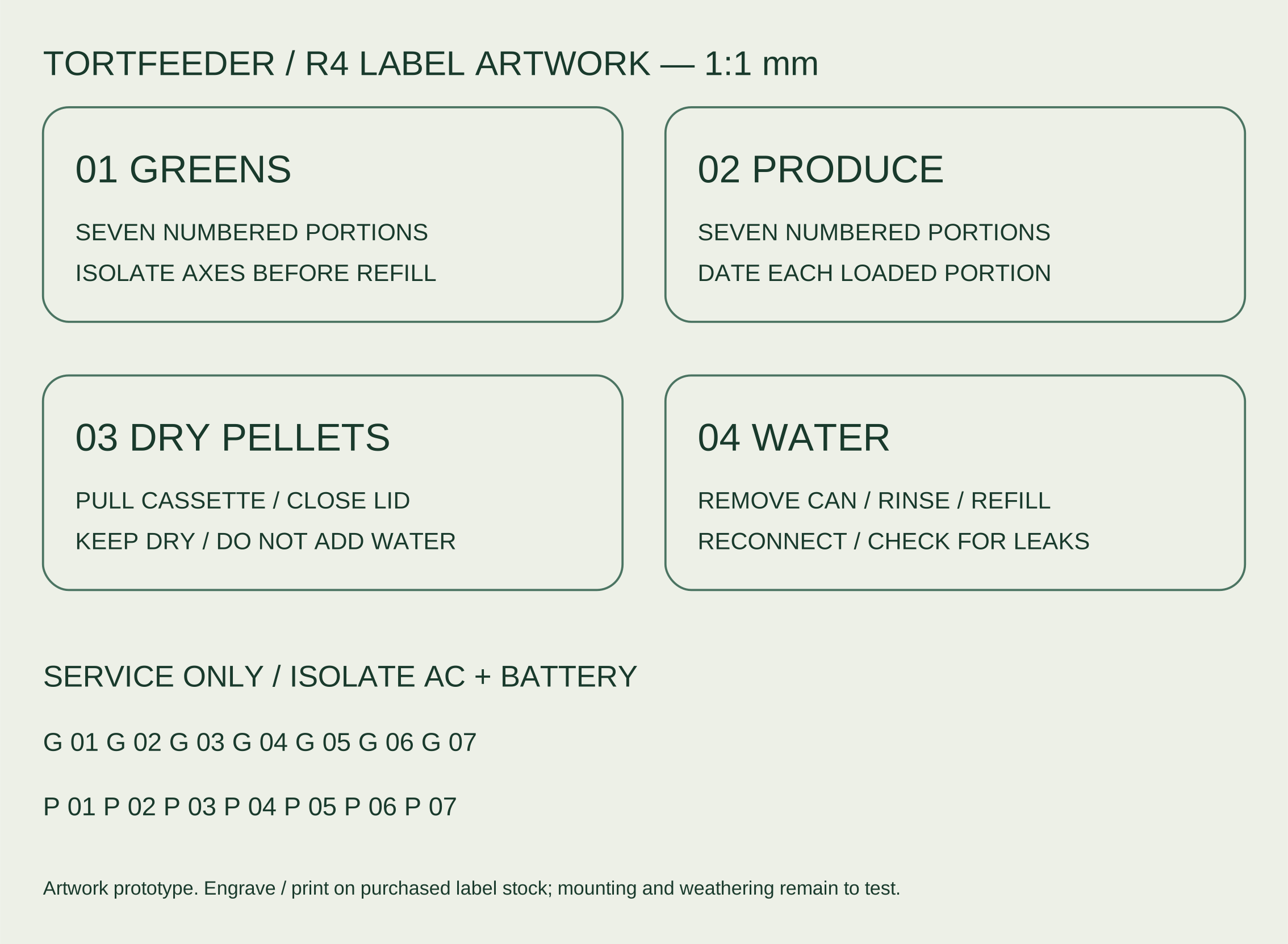
Two inward-folding front doors, matching G01–G07 and P01–P07 tray labels, and a selected-tray refill preview. The chosen carriage parks forward while upright so the original pan can be lifted out, washed and loaded. Both leaves fold into the forward corridor, behind the plate, instead of swinging over the eating area. A real refill mode must isolate motor power, engage a positive support and require door-closed / position checks before resuming. Loaded pans remain dated; the controller needs a separate loaded / empty inventory.
Try “refill selected tray” in the explorer →03 / DRY PELLETSA labeled front refill cassette
The original-size hopper lives at a reachable height in the right column, with a broad pull, sealed lid and clear “keep dry” marking. The animated slide demonstrates access. Its actual docking seal, gate isolation, latch and position sensor remain to design; an open cassette must prevent metering.
04 / WATERA can you can carry to a tap
The existing opaque 2.5 US gallon can is removed through the low front drawer. Refill away from electrical service, then reconnect above the catch tray. Provide a captive pickup, food-contact quick-disconnect, visible low-water state and leak check. There is no open fill funnel over the electronics.
SERVICE ONLY / RIGHT SIDEProtected, separate service access
Tool access opens the outer side panel and then the purchased sealed electrical enclosures. A fixed partition separates the wet front bay from the dry rear bay. AC and battery isolation, heat rejection, wire bend radius and hinge loads remain to engineer. Shade and a drawn enclosure do not establish an outdoor rating.
A buildable visual language
- 01 Warm opaque cabinet skins with forest-green printed interfaces; transparency remains an inspection mode.
- 02 R25 exterior corner covers in short printable segments; R95 / R12 eating surround retained.
- 03 Flush panel faces, supported seams, 3 mm target reveals and fasteners accessible from the service side.
- 04 Text and numbers accompany colour. Fresh food, dry pellets, water and electrical access have different labels.
- 05 Display concept: cold temperature, water level, next portion and explicit “refill open”, “offline” or “inspect jam” states. The model is not connected firmware.
R4 files and sourcing reconciliation
R4 replaces the frame and guide layout. Do not add its entire cut list to the R1 frame or R3 service additions. The reconciled reference BOM removes the superseded long guides, long tray shafts, old cradles and separate logic box. Existing supplier links remain references; order quantities, exact new variants and prices are deliberately unreleased.
R4 complete reconciled reference BOMRetained sources + changed parts; conditional quantities, no new price claim.
CSV ↓Complete replacement frame cuts40 mm McMaster 6575N406; planning cuts matched to the current model.
CSV ↓New R4 mechanisms and interfacesTelescopic slides, short shafts, pivot cradle and printed fascia.
CSV ↓Selectable cabinet print-kit prototypesCorner segment, handle, label frame, seam joiner and slot cover. Not a full structural release.
SCAD ↓Front pivot cradle mockup segmentsSide segments, crossmember half, pivot fork and provisional motor plate. Fit / load validation required.
SCAD ↓Refill and portion label artwork1:1 mm SVG for labels or engraving.
SVG ↓Dimensions and packaging check dataConstants, comparison envelope, rail schedule and open fit questions.
JSON ↓Primary slide reference: Accuride 3832E / 3834E technical sheet. This packaging candidate keeps the slide-and-tip action; it does not inherit validation from the old MGN mechanism.
Digital prototype. Printed mounts, docking connections, insulation, condensation control, motor torque at speed, positive parking supports, anchoring, pan release, cleaning access and tortoise reach / impact tests remain open. The existing engineering studio is an R1 historical model and does not certify R4. All external trim should be tool-retained and kept away from food contact. OpenSCAD prototypes have not been compiled in this environment.