Parts research R1 is available.Open motors, links and BOM. The sourced steel pans and geared stepper bodies still need to be integrated into these generic load and geometry checks; model passes do not establish their fit.
Assembly & kinematics
To scale in orthographic views; schematic hardware envelope in isometric.
PASS means the named simplified check passes; it does not certify a fabrication-ready machine.
Selected tray & actuator
Food motion uses an assumed friction coefficient and adhesion force. Wet greens can bridge or cling in ways this model does not represent. We need cold-food prototype data to replace those assumptions.
Motion interlocks
Mechanism engineering
Fresh food: translate, rotate, return
Each removable tray sits in a pivoting cradle on two purchased linear guides. Its rear-bottom pivot translates forward until the entire rotation envelope clears the storage rack. A belt-driven stepper translates the carriage on two purchased linear guides; a geared servo then tips the cradle. A home latch/support carries resting weight; do not use servo torque as the only restraint. Only one tray may extend at a time.
The clear vertical fall corridor must occupy the full height of both banks. Route harnesses through protected flex loops. The view models the tray and rack envelopes; detailed bearings, fasteners, slide sections, cable sweep and lid mechanism still need CAD.
Outlet & cold boundary
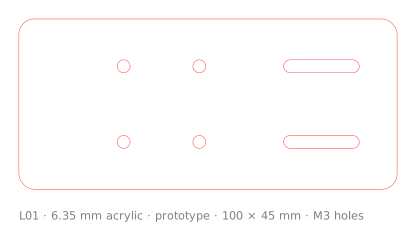
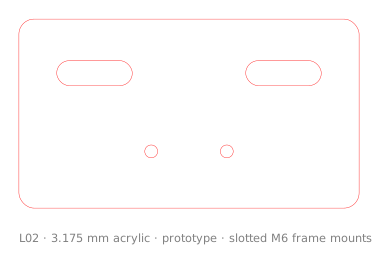
The custom cold shell uses laser-cut acrylic skins, purchased insulation and gaskets. Use an insulated outlet hatch with closed-position feedback. Open it before release; close it after the tray returns and the chute clears. Storage bank, slides and fall corridor are inside the cold enclosure. A hatch obstruction must stop closure. The storage rack AND motion corridor are cold. Only food crosses the lower hatch; trays never leave the cold boundary. Cooling equipment remains unselected.
Pellets: interlocked dose chamber
Fill with upper gate open/lower closed; close and verify upper; open lower into a removable hydration cup; close lower; add measured water; wait for tested softening time; tip the cup to the plate. The pan has no drain hole: water pools around the pellets during the soak. It is retained in a printed cradle with an 8 mm shaft and purchased bearings. The gates must have a mechanical interlock. This diagram is a sequencing concept, not a particle-flow simulation.
Three outer rings, four outer posts, four rack posts, three guide-support rails per tier and two rack crossmembers per tier. Panel mounts, anchors and accessory brackets are additional. Stock allocation uses the selected kerf once per cut, no end trim; it is a valid greedy allocation, not a proof of minimum stock. 40 mm exterior rail envelopes are modeled, not exact vendor CAD. Cantilever supports and acrylic/printed mounts require load testing.
Water, refrigeration & battery model
Heat load is a lumped steady-state estimate. It does not simulate food microbiology, produce shelf life, compressor duty controls, defrost, condensation or battery power-transfer transients. Include required compressor ventilation and a dry, ventilated battery shelter.
Before any production parts order
Measure actual greens/vegetable portion volume and mass. Load values are engineering assumptions, not a diet prescription.
Build one tray, slides and pivot. Check every swept clearance and measure required force/torque with real cold wet food.
Measure food release behavior after 1, 3 and 7 days cold storage. Establish acceptable refill interval; a fridge does not establish seven-day freshness.
Choose a refrigeration appliance or professionally assembled cooling system from the required interior envelope. Do not drill an appliance shell or refrigerant lines.
Resolve tray covers, gasket motion, condensation drainage and tool-free cleaning. Bearings and actuators must be isolated from food contact.
Validate frame deflection, joint strength and anchors against measured loads; this studio only estimates static overturning.
Test actuator stall, missing plate, open hatch, Wi-Fi loss and reboot mid-release. No automatic retry of an uncertain portion.
Test blocked-water outlet, broken tube, siphon and independent maximum run-time cutoff. Keep a clean drinking dish continuously available.
Run a supervised full-capacity thermal trial in the hottest expected weather with an independent temperature logger.
Arrange daily plate/preparation-cup cleaning and animal checks. Automatic cleanup is outside this mechanism design.
Model boundary
The geometric checks are two-dimensional solid-envelope tests for one bank, sampled at 1 mm translation and 1° rotation. No FEA, flexible leaf simulation, discrete pellet simulation, refrigeration CFD or hardware certification is performed. Rendering and calculations derive from the same configuration.